Getting to Know the Aspen Investment Team
Headed up by Aspen Group Chief Investment Officer, Aileen Mathieson, the Investment team is considered one of the core pillars of value generation for our...
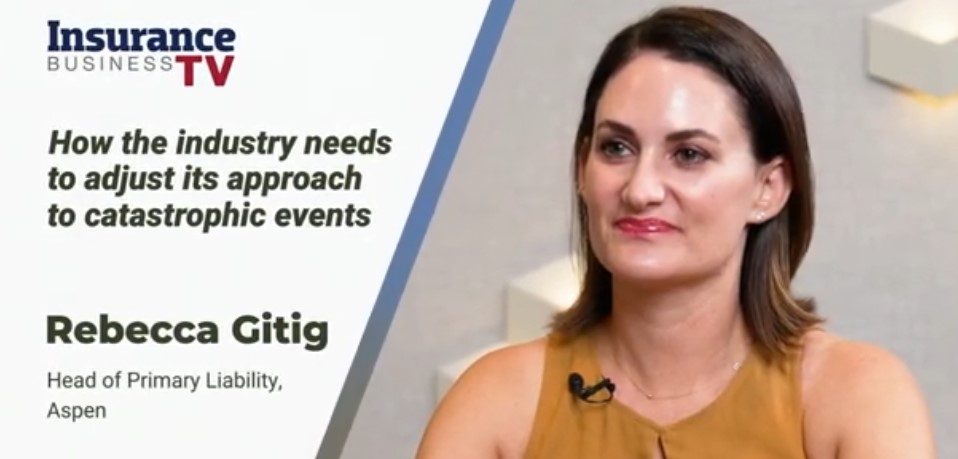
Rebecca Gitig, Aspen U.S. Head of Primary Liability, spoke with Insurance Business TV recently about the growing challenge of casualty catastrophe losses, particularly the rise of mass torts.
What were once considered “once-in-a-decade,” mass tort events are now occurring almost annually. Rebecca emphasized that casualty risks—such as PFAS, glyphosate and other emerging liabilities—must be modeled, analyzed and priced differently, much like how Property lines adapted to catastrophe modeling in the 1980s. Unlike property catastrophes, casualty exposures are long tailed, evolving over many years, and the insurance industry has not yet fully accounted for aggregation and clash event exposure in its pricing models.
When discussing the Excess & Surplus market, Rebecca noted E&S has experienced six consecutive years of double-digit growth. While some cyclical moderation is expected, the long-term demand for creative solutions that address challenging exposures remains strong. New and increasingly complex risks continue to emerge, and what was once considered an isolated event is now becoming systemic.
In Casualty lines, habitational real estate serves as a key example. Viewed primarily as a trip-and-fall exposure, it has evolved to include assault and battery claims, habitability issues, human trafficking claims, compounded by the increase in the severity of trip-and-fall (premises) liability. These exposures have become too challenging for the admitted market to absorb, positioning the E&S market as a critical provider of flexible, customized solutions. New offerings, such as Active Assailant coverage, demonstrate this adaptability and creativity.
When asked where E&S presented opportunities, Rebecca highlighted social inflation in primary and excess liability lines of business, explaining that its unpredictability continues to strain the admitted market. In contrast, the E&S market’s flexibility in policy forms, specialized underwriting and customizable solutions allows it to respond quickly and withstand the aggregation risk of those exposures in the long term. While growth may moderate from recent highs, the demand for E&S solutions is expected to remain sustainable over the long term as the complexities and challenges of the global risk landscape continue to evolve.
View Rebecca’s video interview here.
In contrast, the E&S market’s flexibility in policy forms, specialized underwriting and customizable solutions allows it to respond quickly and withstand the aggregation risk of those exposures in the long term.
Rebecca Gitig U.S. Head of Primary Liability
Headed up by Aspen Group Chief Investment Officer, Aileen Mathieson, the Investment team is considered one of the core pillars of value generation for our...
In part two of our two-part series, “Getting to Know the Environmental Team,” we spoke with Cassandra Phillips, International Environmental Underwriter who joined Aspen in April...

We sat down with Erin Brown, Vice President, U.S. Environmental, who joined Aspen in 2011, to find out what a typical day in her role...